Pattrnz

Pattrnz portfolio

Projects that make early-stage procurement tangible

A selection of public tools, partner pilots, and published infrastructure developed by Pattrnz. Each project runs on dedicated infrastructure and follows the access model required by its partners and data.

“Evidence-backed” refers to signals such as contract history and structured records. It does not mean that Pattrnz certifies suppliers.

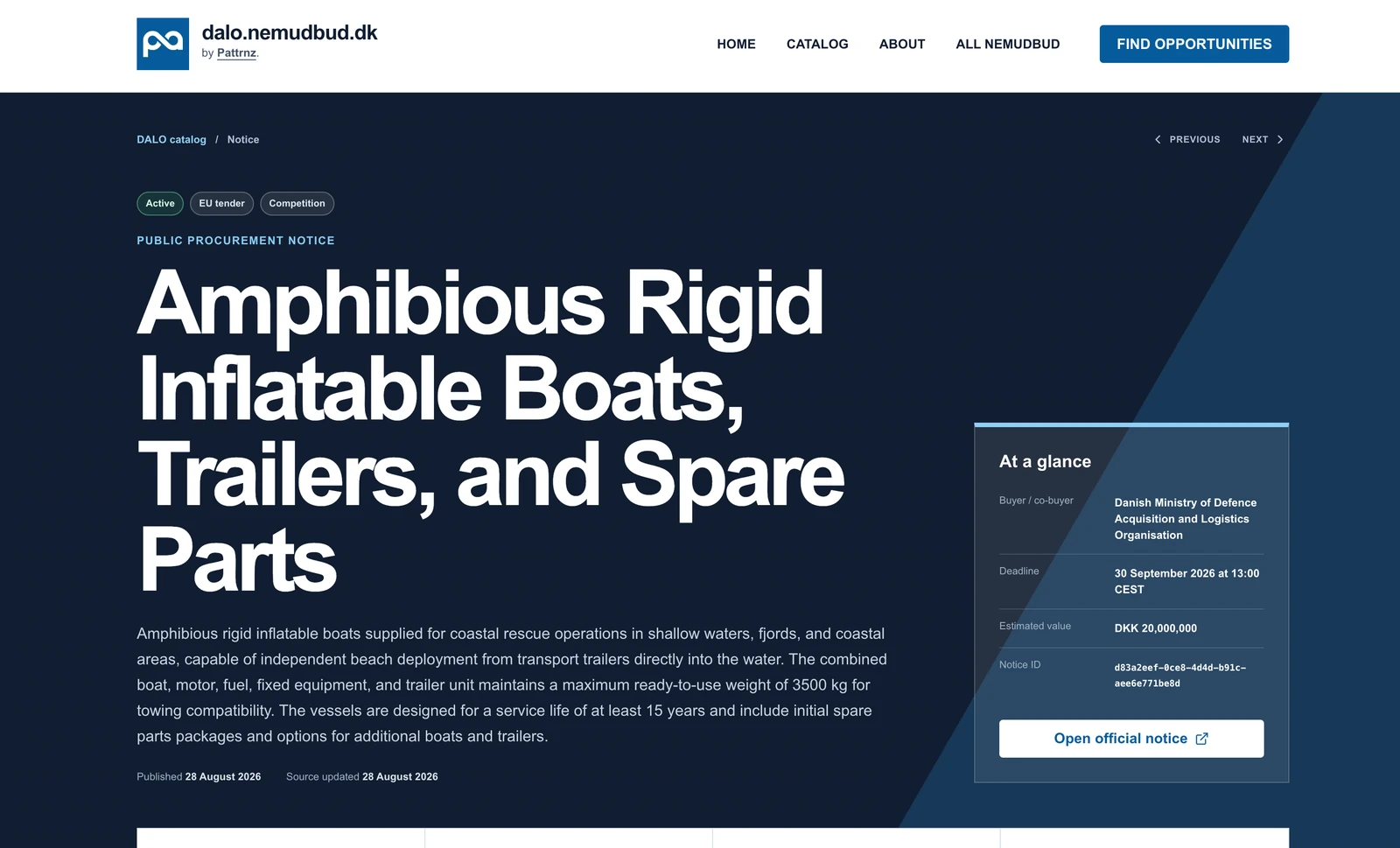
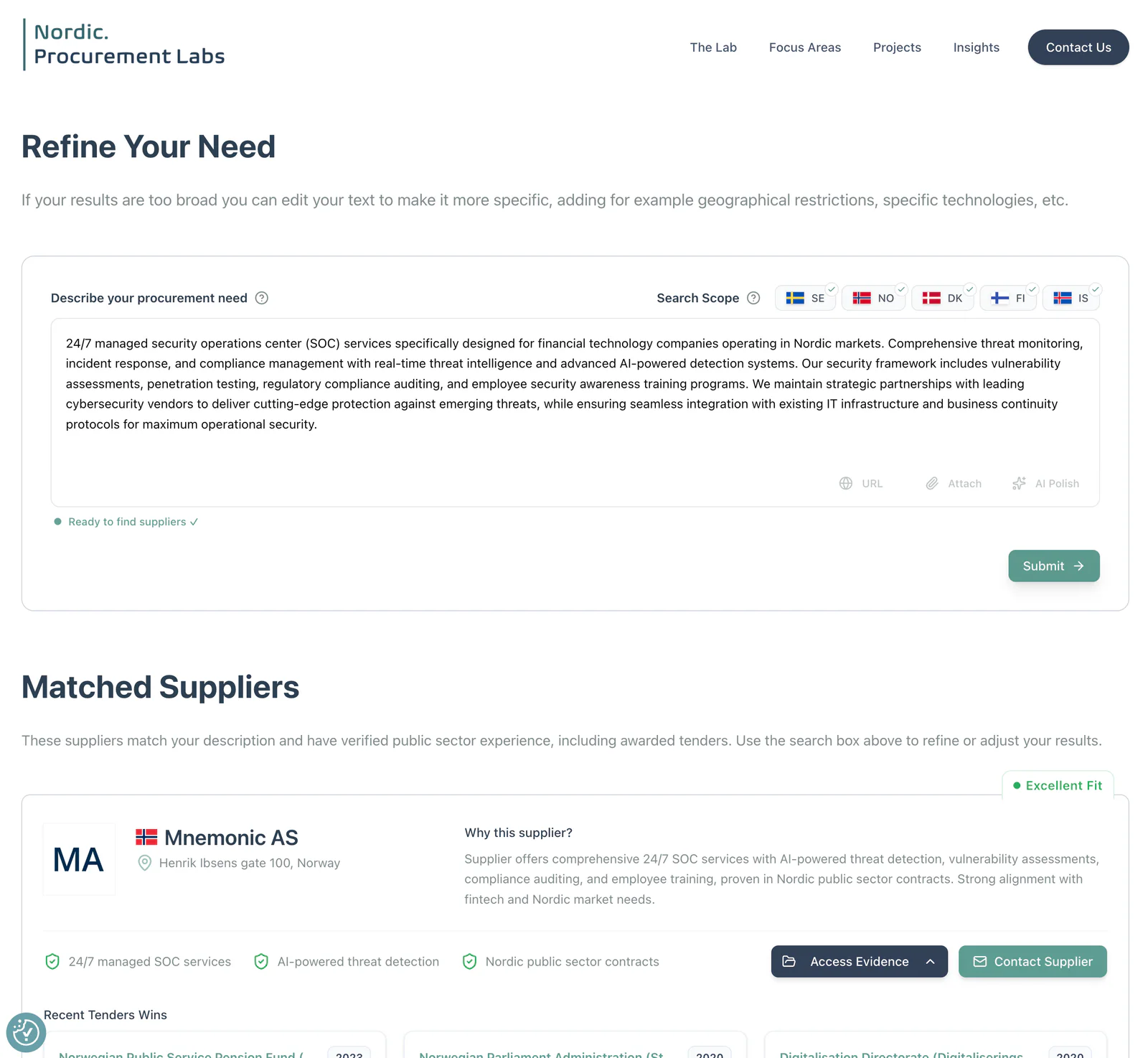
Nordic Supplier Discovery Tool — product interface screenshot
01
Open betaAccess: Public

Nordic Supplier Discovery Tool

Public procurement teams, resilience planners, strategic-sector buyers, and suppliers seeking visibility

A public-access discovery tool that lets users describe a procurement need in natural language and returns an evidence-backed shortlist of relevant Nordic suppliers. Results are grounded in procurement records rather than marketing claims.

Why it exists

Supplier discovery in cross-border markets is slow and biased toward incumbents. Many capable SMEs remain invisible because they do not use the same language as tenders and do not have the reach to market themselves across countries. The tool reduces discovery friction while keeping results grounded in evidence.

What it enables
  • Faster discovery for complex needs, including categories that do not map cleanly to keyword search
  • Cross-border visibility of capability signals across the Nordic region
  • More transparent shortlisting, supported by traceable evidence from procurement records
How it works
  • Users describe needs in their own words
  • The system matches against structured procurement records and supplier capability signals
  • Results include traceable evidence so users can validate why suppliers were surfaced
Data basis and coverage
  • Built on procurement data sources used across Nordic Procurement Labs workstreams, including national tender sources and EU TED where relevant
  • The supplier universe referenced in Nordic Procurement Labs materials exceeds 40,000 suppliers
Related projects
  • Nordic Defense Procurement Report and Dashboard — context and shared data patterns
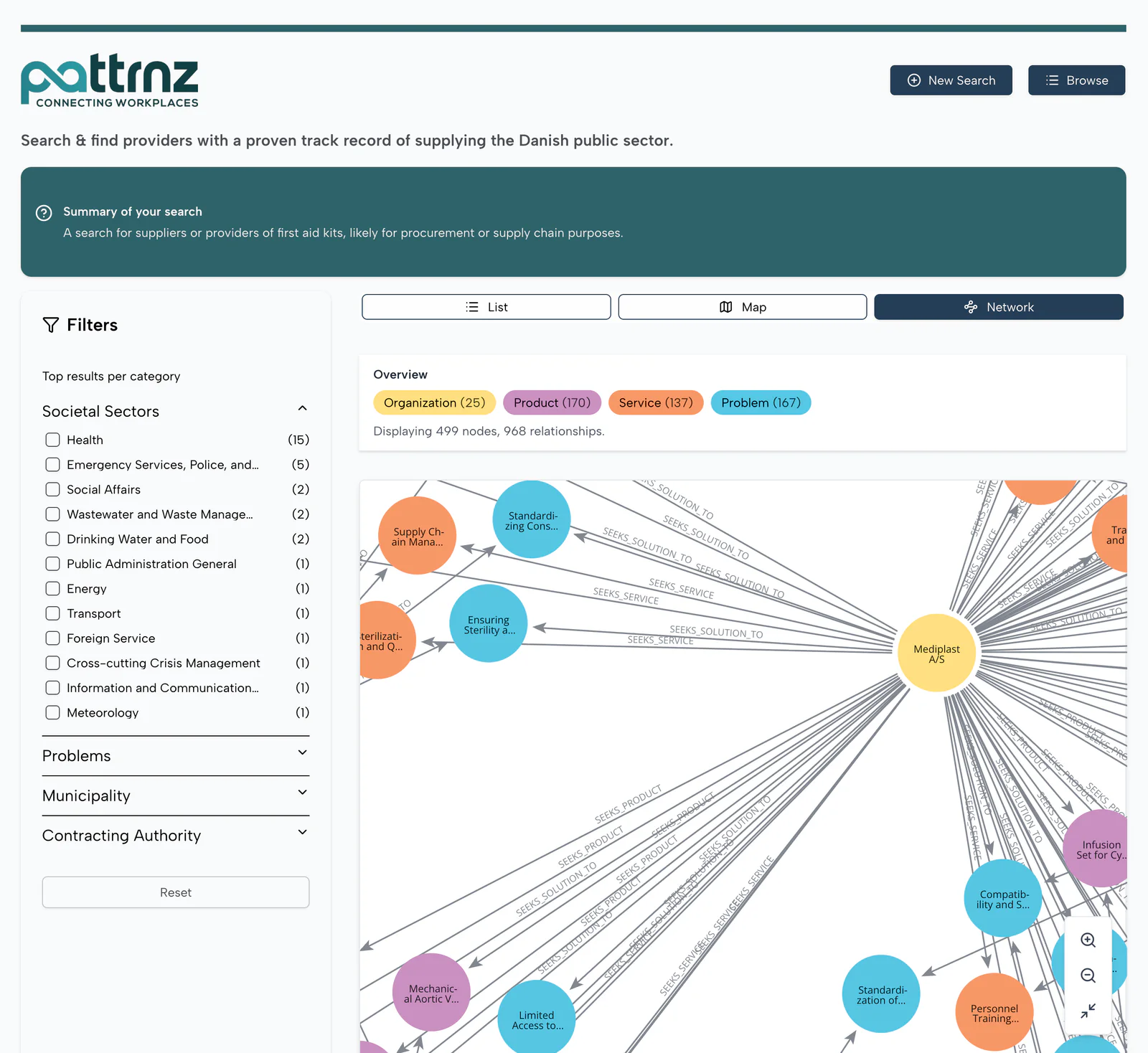
SAMSIK Resilience Pilot — product interface screenshot
02
Restricted pilotAccess: Restricted partner environment

SAMSIK Resilience Pilot

Resilience and emergency management stakeholders, and public agencies responsible for continuity planning

A pilot platform demonstrating how AI and knowledge graph infrastructure can support resilience planning and crisis readiness by mapping procurement and supplier relationships. The aim is to support faster mobilization decisions during emergencies and improve preparedness before incidents.

Why it exists

In a crisis, manual outreach and fragmented spreadsheets do not scale. Agencies need a credible way to identify suppliers with documented delivery history, understand concentration risk, and see potential single points of failure across critical categories.

What the pilot demonstrated
  • Rapid surfacing of suppliers with documented public-sector delivery history, using open tender data
  • Ecosystem views that reveal concentration patterns, geographic “supply signatures,” and supplier collaboration networks
  • Decision-support outputs that can be used for preparedness planning, not only retrospective analysis
Scope and deliverables
  • Carried out from January to May 2025
  • Methodology and findings report
  • Workshop and presentation
  • Data model and schema documentation
  • Knowledge graph database export
  • Technical documentation and sample queries
  • Functional interactive front-end demonstration
Data basis and coverage
  • 9,864 contracts analyzed
  • 3,344 unique suppliers identified
  • Based on five years of open Danish public tender data, with enrichment including CVR metadata as referenced in the pilot materials
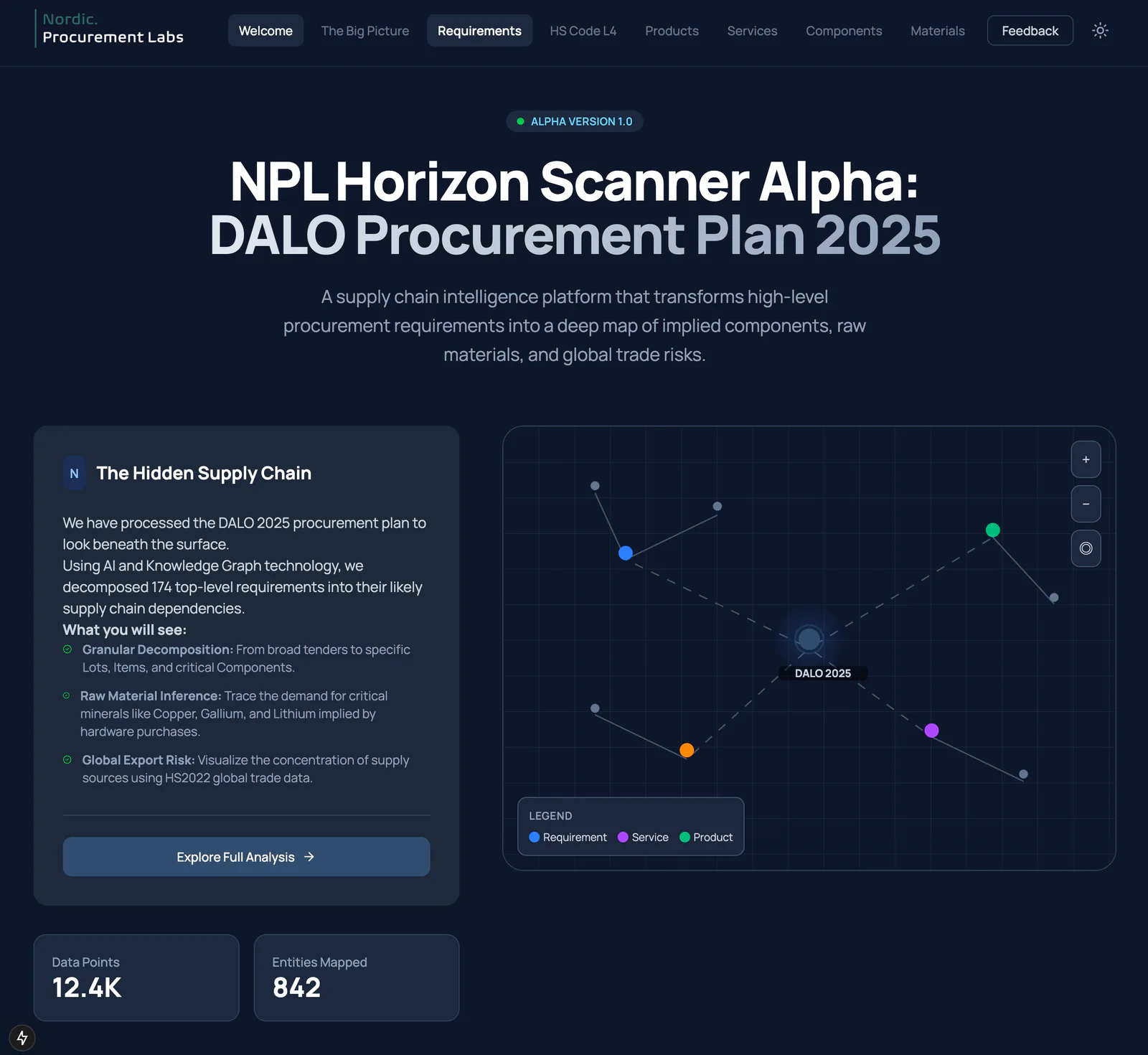
Horizon Scanner — product interface screenshot
03
AlphaAccess: Demo or partner access

Horizon Scanner

Defense and strategic-sector procurement teams, capability planners, industrial-policy and resilience stakeholders

An AI-powered infrastructure that ingests procurement plans and restructures them into a traceable, multi-tier demand and dependency map. The purpose is to convert static planning documents into structured representations that support earlier market engagement and earlier visibility into dependencies.

Access available by demo or through partners
Why it exists

Strategic-sector procurement faces a volume and visibility problem: plans are often published as broad line items that are hard for suppliers to interpret and hard for buyers to operationalize. Authorities face high inbound noise and limited capacity to triage proposals. Multi-tier dependencies are difficult to see early, especially beyond tier 1.

How it works
  • The system simulates tender structure by decomposing a plan into: Requirement → Lots → Items → Components → Materials
  • It then enriches the decomposed entities with structured identifiers and overlays trade and concentration-risk indicators where applicable
MVP results demonstrated
  • A defense purchase plan with 174 top-level requirements was mapped into 12.4K data points and 842 mapped entities
  • End-to-end processing was reported as under one hour for ingestion and restructuring of a full annual plan
What it enables — for buyers
  • Earlier, structured visibility into what the plan implies in practice
  • Better market-engagement design before tenders are formalized
  • Dependency views that support mitigation options, not only risk flags
What it enables — for industry
  • Earlier heads-up signals that improve alignment before tenders are locked
  • Better translation between civilian capabilities and defense-relevant demand categories
  • Clearer pathways for consortium formation when suppliers cover different layers of a requirement
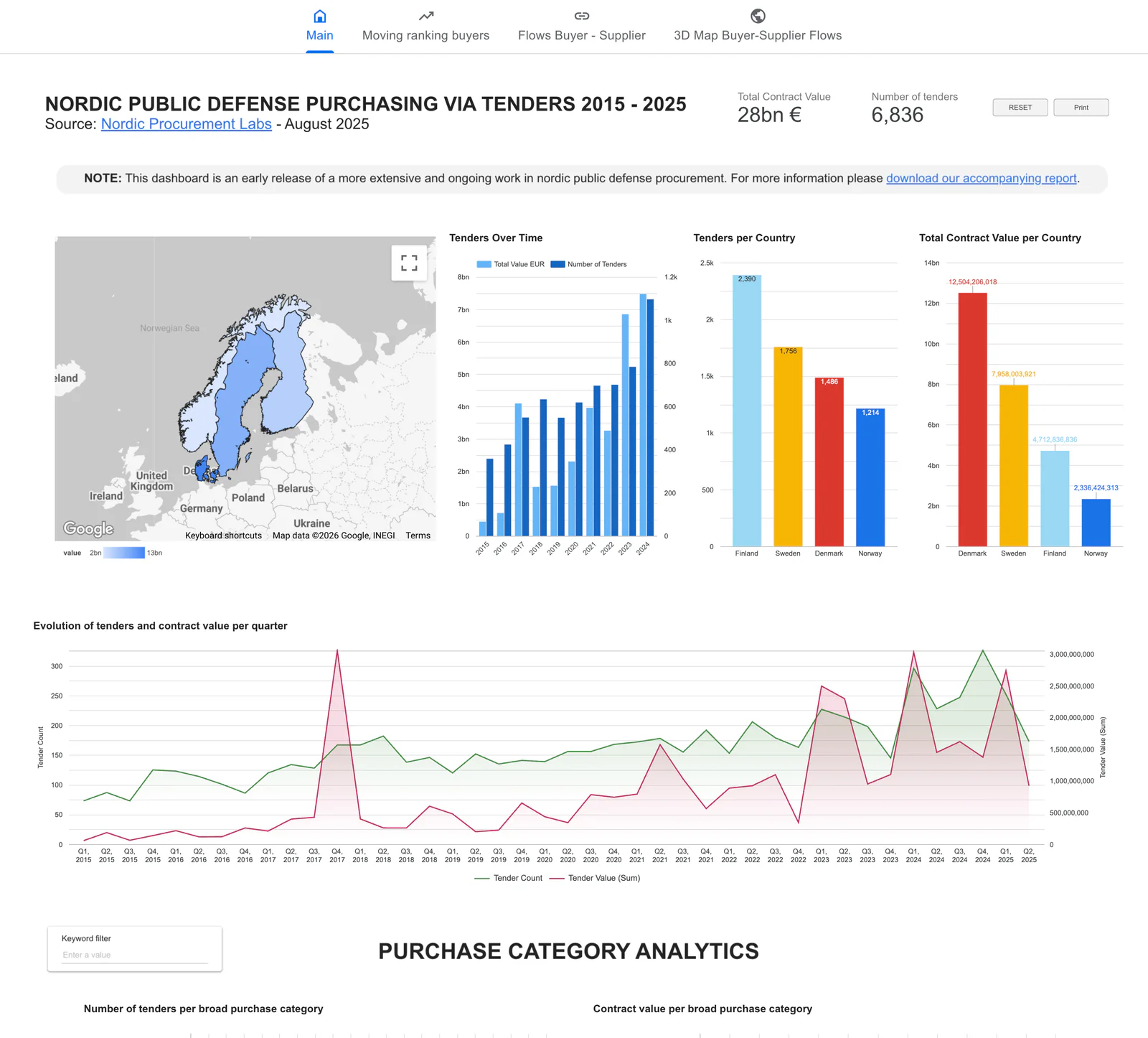
Nordic Defense Procurement Report and Dashboard — product interface screenshot
04
PublishedAccess: Public

Nordic Defense Procurement Report and Dashboard

Defense procurement stakeholders, strategic-sector policymakers, defense industry, analysts, and researchers

A public report analyzing Nordic defense procurement trends from 2015 to 2025, paired with an interactive dashboard that supports deeper exploration than the static report.

Why it exists

Defense procurement discussions are often based on anecdotes, partial snapshots, or narrow categories. This project provides an evidence-backed view of procurement patterns across the Nordic region, including where activity concentrates and how buyer-supplier relationships form across countries and categories.

Data basis and coverage
  • 6,836 tenders across Denmark, Sweden, Finland, and Norway
  • Total value analyzed: EUR 27.5B
What the dashboard adds
  • Filtering by country, category, and time period
  • Exploration of buyer-supplier relationships and concentration patterns
  • A shared evidence base that supports strategic discussion without requiring access to restricted systems
What it enables
  • Faster pattern discovery for strategic planning and policy design
  • More transparent grounding for market discussions and industry planning
  • A reference point for consortium discussions about resilience and strategic autonomy

Ready to improve early-stage procurement?

Choose one or two priority procurement categories for a Solution Sprint. Define the baseline, test the workflow, and decide what to scale—or use the value simulator to estimate the potential impact on cost, time, and risk before the RFx.